“Last year we had no snow here,” the hotel desk clerk in Anchorage (Arctic) said.
That got my attention, because this is Alaska, after all.
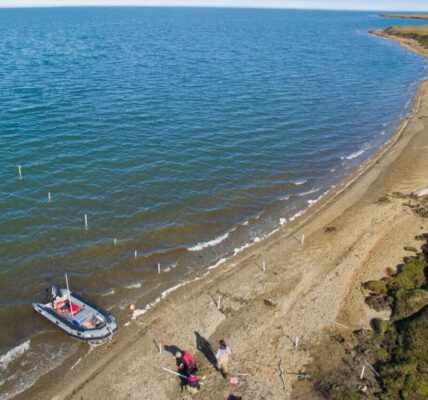
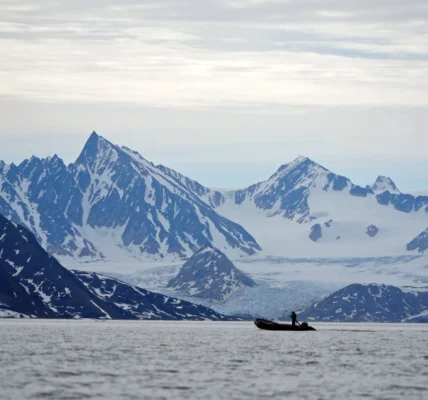
We were collecting our room keys for an overnight stay before our journey’s end, a flight to Utqiaġvik, Alaska, the “top of the world.” The village, which was formerly known as Barrow, is situated along the Arctic’s North Slope that abuts the Chukchi Sea, a part of the Arctic Ocean.
It is the northernmost settlement in the United States. No roads lead here.
Last September, I traveled to this far north outpost as part of a research team from the Scripps Institution of Oceanography, which also included principal investigator and climate atmospheric chemist professor Lynn Russell and Ph.D. student Sourita Saha.
We were headed to the National Oceanic and Atmospheric Administration’s Global Monitoring Laboratory in Utqiaġvik as part of a five-year project to collect atmospheric aerosol data. The measurements will add to the data set previously collected here over some 30 years and include novel measurements as well.
“Aerosols are important because they may cause warming or cooling, either directly by reflecting or absorbing radiation, or indirectly by making clouds,” said Saha.
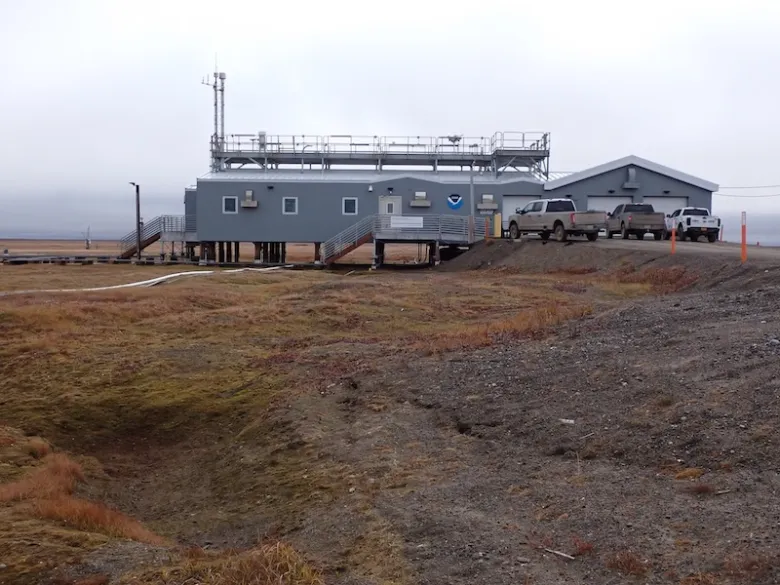
Utqiaġvik is ideal for aerosol studies, as the Arctic has experienced warming that is around three times faster than in the lower latitudes. The remote location also reduces interference from locally generated human activities.
Part of aerosols’ claim to fame is their ability to promote cooling via cloud formation during summer’s sunny days. To make a cloud, aerosol particles (e.g., salt, dust) must first form cloud seeds, and these must be able to make cloud droplets that culminate in a cloud.
Not all cloud seeds lead to droplets, and not all droplets result in clouds, making this complex process critical to understand. To be clear, the warming effect of greenhouse gases is larger than the cooling effect of aerosols on clouds, but if it was not for aerosols, Earth would be even warmer than it already is.
Another thing: don’t confuse aerosols with greenhouse gases like carbon dioxide, though they both affect the climate. For one thing, aerosols aren’t gases; they are solid, liquid, or a mix of solid and liquid particles. For another, they don’t travel the planet and linger in the atmosphere for years or centuries like gases. Instead, aerosols may remain airborne for less than a week, so their effects are primarily local.
We landed at the airport in Utqiaġvik, population less than 5,000, where it was a brisk 35F degrees. Locals like to say that Utqiaġvik has two seasons: ice and mud; we were here for the latter. After navigating mud and puddles to access our ready-for-all-Arctic-conditions pickup truck, we headed to the Alaska Commercial Company for provisions.