“The Arctic is no longer a quiet corner on the map. It is the front line of the global power competition.”
Humanitarians, traditionally, have had little reason to think of the Arctic. But the recent transatlantic political crisis – sparked by an overt bid from the United States to annex Greenland – has highlighted a region with dynamics sharing stark parallels to crises across the Global South.
Most starkly, climate change – by way of melting Arctic ice – is a critical underlying factor in what has been termed a new geopolitical “great game” in the frigid polar region, in which the world’s major powers seek advantages.
There are eight Arctic states: Russia, and NATO members Canada, Denmark, Finland, Iceland, Norway, Sweden, and the United States. But many others show an interest, including India, and China, which in 2018 declared itself a “near Arctic state” and outlined its plan to open a Polar Silk Road shipping route.
The retreat of Arctic ice, itself a major ongoing environmental disaster, is opening new shipping routes and coincides with a thirst for extracting energy resources, both fossil and transition fuels. This scramble is occurring as regional multilateralism fades: Despite a constructive past, there are no longer serious ties between Russia and other Arctic states. Meanwhile, militarism is increasing, with nerves heightened by the presence of the world’s largest nuclear arsenal on Russia’s Kola Peninsula, and the testing of new weapons systems.
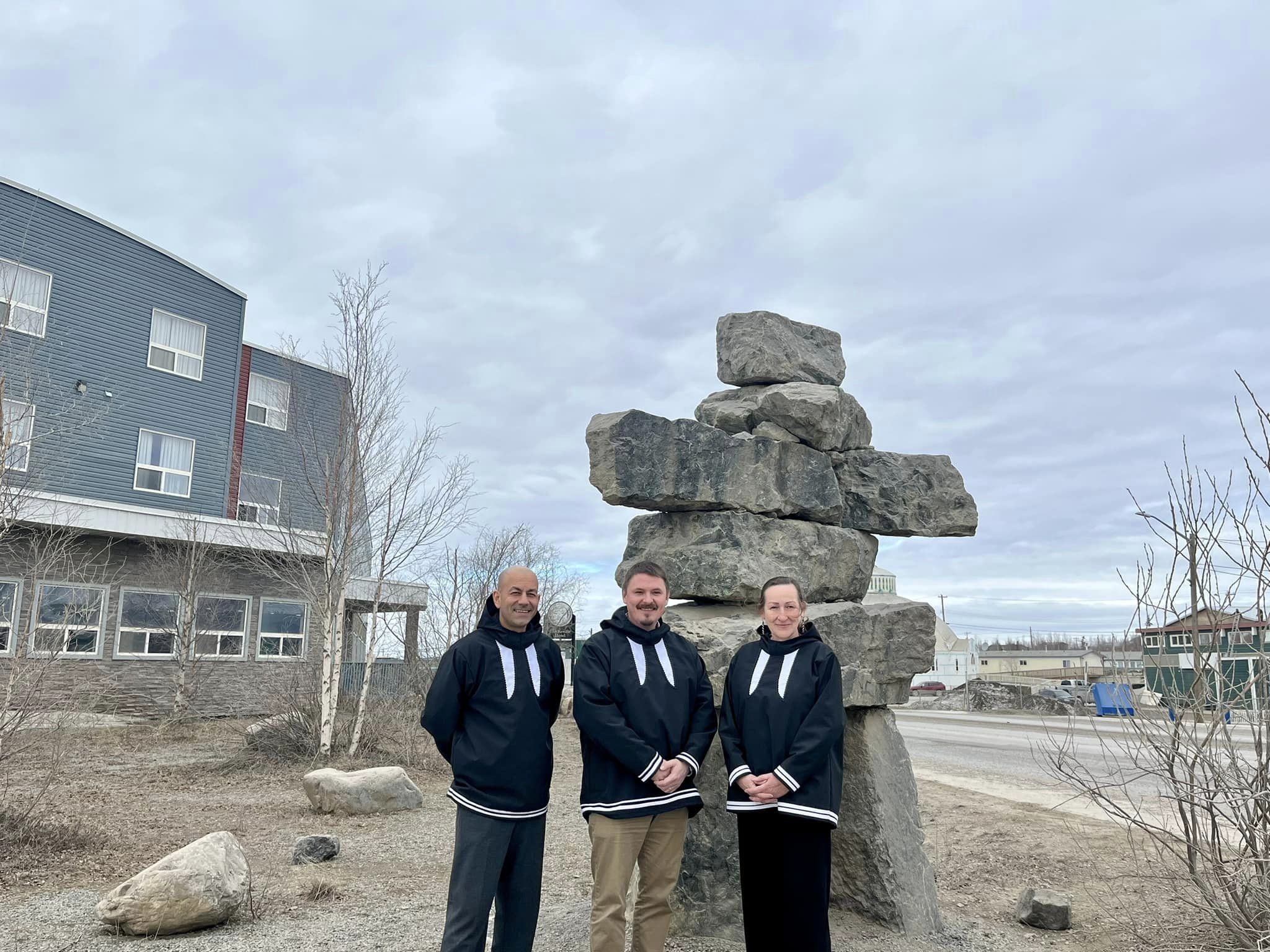
Stuck between the great powers are Indigenous communities, whose relationships with the state vary between degrees of animosity, reconciliation, and fear – including of a new era of Arctic colonialism.
“For quite some time, the Arctic has been the region of low tension and high cooperation,” EU foreign and security policy chief Kaja Kallas told a press conference at the Arctic Frontiers conference in Tromsø, northern Norway last week. But, Kallas continued, “The United States’ outspoken claims to Greenland underline the simple reality: The Arctic is no longer a quiet corner on the map. It is the front line of the global power competition.”
The New Humanitarian attended the 3-4 February Arctic Frontiers event, which seemed to confirm – through the winks of diplomats and subtle reactions of politicians – the increased European wariness of the United States. These are the main takeaways for humanitarians curiously looking north.
Climate insecurity and the thirst for new resources
Climate change has long affected the Arctic, where warming is happening around four times faster than the global average. This has many harmful effects on the planet, but perhaps the most critical for geopolitics is the melting of sea ice, which creates new shipping and submarine routes. Less ice also means more access to large reserves of fossil fuels, which cause climate change; and critical minerals, which are needed for clean energy to reduce the causes of climate change, as well as new technologies.
“The Arctic is hot,” Espen Barth Eide, Norway’s foreign minister, told a press briefing. It “remains the number one challenge to mankind to curb global warming to deal better with nature and our environment”.
Norwegian Prime Minister Jonas Gahr Støre called the Arctic the “canary in the coalmine” for how climate change affects the world, adding, “so it matters to all countries security”.
Neither politician, however, mentioned their government’s approval to develop 57 new fossil fuel extractive projects just this year.
Intelligence services are warning that climate impacts create “security risks” as new sea lanes open, including because of Chinese leverage over the world’s critical minerals supply, said Kallas. “Climate change is the biggest risk here and globally,” she added.
In Greenland, there’s “access to more land with the climate change, access to more raw materials”, said Aaja Chemnitz, an MP from the semi-autonomous region who sits in the Danish parliament. This is one of the factors incentivising the attempted US annexation of Greenland: It is seeking to secure more control over critical minerals supply, which the administration believes is a national security priority.
Greenland also suffers from climate disasters like landslides and flooding, Chemnitz told The New Humanitarian in an interview. Malou Platou Johansen, a Greenlandic marine biologist, explained how much of the territory was lacking snow this winter.
Despite the disproportionate impact climate change is having on Greenland environmentally and politically, Chemnitz stressed “it’s not us who’s polluting” – reminiscent of climate campaigners from across the Global South. Talking about climate change should also be accompanied with discussions about Indigenous people’s rights, added Chemnitz.
Greenland and the legacy of colonialism
Much media coverage of Greenland’s political crisis has focused on the political aspects, on which the overriding message of political leaders at the Arctic conference was to cool the temperature. But it is Greenlanders themselves who have been most hurt by being subject to US imperialist ambitions.
The experience has been “overwhelming”, said Platou Johansen. “It’s hard to think about when a guy with so much power can speak to us like that. It’s inhumane.” She, like other sources consulted by The New Humanitarian, said the US has been “active in Greenland for a while, they are just doing [it] more vocally now.”
Politically, the territory is, for now, opting for an uneasy status quo. “Greenland chooses the Greenland we know today as part of Denmark and NATO,” said the territory’s foreign minister, Vivian Motzfeld. “Self-rule, self-determination, must continue. We want respectful dialogue through diplomatic and normal channels.”
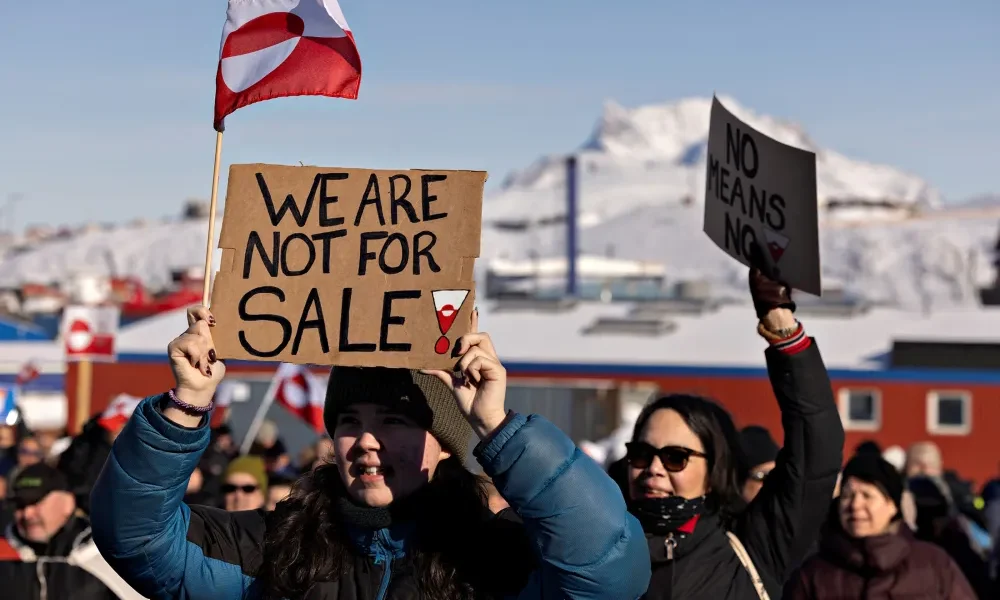
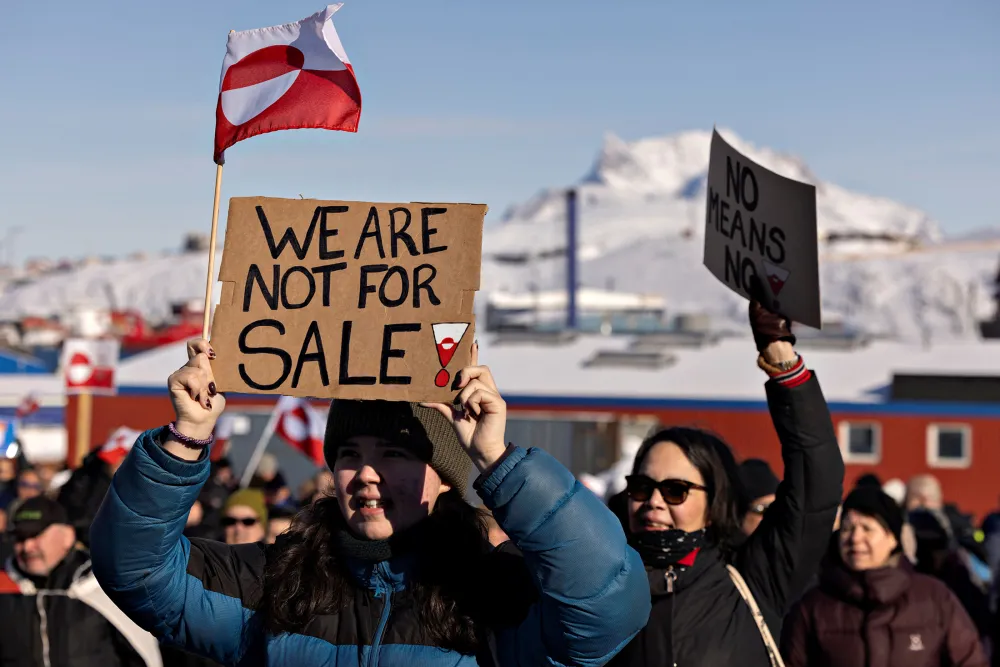
Chemnitz, an MP, was more blunt. “Greenland is not for sale,” she said. “The more capitalistic way of buying a country or buying a people, and even talking about a ’big chunk of ice’ without talking about the people that live there… is really appalling to me,” said Chemnitz. “So it’s been quite offensive the way that things have happened.”
Chemnitz’s remarks tapped into a broader dynamic rippling through Arctic policy: colonialism. While Denmark and Greenland are now presenting a united front to the world, the relationship between the two countries has been troubled.
Greenland graduated from a colony to become part of Denmark in 1953, but colonial dynamics persisted. While there have been attempts at reconciliation, Inuit girls and women from Greenland were fitted with birth control devices without their knowledge or consent as recently as 1991, a report found. Danish authorities have been accused of unjustly breaking up Greenlandic families, and racism against Inuit Greenlanders in Denmark is well documented. Meanwhile, EU spending in the territory only increased amid the recent political crisis.
The United States is believed to have exploited these colonial dynamics in a bid to impose its own stamp on the territory. “We have seen lies about how things are in Greenland,” said Chemnitz. “Do we have challenges? Yes. Do we have things we need to talk about between Greenland and Denmark with each other? Of course, but we shouldn’t do that in the press.”
Colonial dynamics in the Arctic are not limited to Denmark and Greenland. Indigenous communities in many Arctic countries have endured injustices, and today many suffer much higher rates of disease, suicide, and poverty than national averages.
“We have a TB [tuberculosis] rate of over 600 times the national average. We have a life expectancy of 10 years less than other Canadians. We have high rates of poverty. We don’t have a full healthcare system [just referrals],” said Natan Obed, president of the Inuit Tapiriit Kanatami, a national organisation representing Inuits. “We are not in any way close to bridging the infrastructure deficits that exist in our communities.”
“The concerns we have as Inuit go back as far as the 1940s and 1950s, when Canada and its allies… did whatever they wanted in the Arctic… sometimes displaced us… and then left a mess. We don’t want to see that happen again.”
Indigenous communities also suffer most from extractive activities, according to Professor John Smol, a biologist at Queens University, Canada. “Mines are often not cleaned up, often leaking contaminants for decades after the mine’s closure… it’s a social justice issue which must be addressed,” he said in a speech at the conference.
Despite the structural inequities, the deep environmental knowledge of Indigenous groups was widely recognised, including by disaster planners.
The input of community elders is vital for mapping weather impacts – including typhoons – to create “data you can’t get anywhere else”, said Jereme Altendorf, associate director of Arctic programmes at the University of Alaska Anchorage. Humanitarians will be familiar with his advice for building trust: “Actually being there [in communities] and taking time to ask questions. Often officials set their agenda: That doesn’t necessarily work for communities.”
As activity ramps up in the Arctic, Indigenous leaders stressed that their communities priorities should not be forgotten.
“The new militarisation of the Arctic is an extension of existing military presence across Inuit Nunangat, our homeland,” said Obed. “The concerns we have as Inuit go back as far as the 1940s and 1950s, when Canada and its allies… did whatever they wanted in the Arctic… sometimes displaced us… and then left a mess. We don’t want to see that happen again.”
Like other speakers, Obed stressed that Indigenous communities should benefit from new defense spending going into the Arctic. “We are the basis and foundation of Canadian sovereignty of 40% of Canada. That has to mean the security of our people is also the foundation for any of the defence that Canada considers for Canada,” he said.
Despite the renewed great power interest in annexation, there were also optimistic notes on Indigenous rights in the Arctic.
“We live in a different time,” said Obed. “The idea of imperialism, of conquest, Manifest Destiny… those very rightly belong in the 16th and 17th century. How we push against some language we hear, whether from the United States or other nation states with nefarious intent, is to lean into the arrangements that we have made which describe a new way of thinking about the nation state and territorial sovereignty.”
There must be “nothing about us without us”, said Chemnitz. “We’ve been fighting for centuries, we will fight for centuries to come… It’s going in the right direction.”
Increasing militarism and the nuclear threat
The Arctic, while peaceful, has long been of interest to military planners: The shortest flight path for missiles between the United States and Russia is through the region. A major pretext for US claims over Greenland is on security grounds, amid claims from the Trump administration that the territory is seeing increased activity from Chinese ships. But European leaders, as they rallied to support Greenland and lower the temperature with the United States, have been keen to put the focus back onto Russia.
Despite the Greenland crisis, which threatened to fracture NATO, a major planned training exercise in Norway and Finland – dubbed Cold Response – is going ahead in March with the participation of thousands of US troops.
But NATO’s position has clearly been complicated by President Trump.
“Europe must catch up with the Russian military build-up across the region,” said Kallas, in a speech announcing a new EU Arctic strategy. “We cannot ignore… the radical change in the US thinking, and that marks a structural shift in transatlantic relations… The EU understands that Greenland is strategically important for the United States. It is also important for us in the European Union. Nearby are key submarine lanes, beneath are critical raw minerals essential for the global economy, and the shortest flight path for strategic missiles runs across the High North. This is recognised by all.”
While Norway’s mantra is “to maintain High North low tension… we cannot rule out facts of geography”, said Støre. “A country restoring the Leningrad military district is a country we have to watch out for,” he said of neighbouring Russia.
Støre said he told Trump that missiles “pointed at you are 100 kilometres from us. We should be glad we collaborate. We [Norway] are [the] eyes and ears of NATO in the north. This is where Russia is testing weapons, from where submarines sail. We know a lot about that.”
Russia likely also knows a lot about what Norway is doing too: The latter has reported increased espionage in Svalbard and other High North regions.
“We cannot ignore… the radical change in the US thinking, and that marks a structural shift in transatlantic relations.”
The recent entrance of Sweden and Finland to NATO has improved Støre’s confidence on security matters. The Nordic countries “had cooperation before NATO, but now it’s different when we can do it with interoperability,” he said. “The number of fighter jets united in one force is more powerful.” Finland’s artillery is among the largest in Europe.
Despite the reassuring words from the politicians, Lars Saunes, former chief of the Royal Norwegian Navy, spelled out a more pessimistic analysis. “We need to think about how we calm down the weapons escalation… happening in the Arctic,” said Saunes, now a professor at the US Naval War College.
“When Russia is finished in Ukraine, [the] Arctic is next,” Saunes told a panel. “They will generate forces in the Arctic because that is the most important area for Russian strategic forces.”
For NATO’s part, Saunes said, “I think escalation management and [to] avoid a nuclear escalation is perhaps the most important task for the future, especially for the Arctic operations.”
Declining international cooperation… and fewer channels to deal with risks
The Arctic Council is the main multilateral body dealing with issues affecting the region – except security, which was deliberately excluded from its founding agreement. But Russia’s full-scale invasion of Ukraine in 2022 disrupted the council’s work on scientific, environmental, and search-and-rescue issues.
“The status quo is not good,” said Barth Eide of the Arctic Council, which is now 30 years old. He described its current work as a “holding operation to keep [a multilateral] apparatus alive while working for better times elsewhere”.
Russia is by far the largest Arctic state, making up more than half of the region. But the rest of the Council – now all NATO members – “cannot work with Russia in the old ways”, said Barth Eide, flagging the fact that there are no political-level meetings and its work is very limited. Aleksei Dudarev, a Russian scientist who contributed work to the Arctic Council, was recently arrested on treason charges – a further sign of the body’s entanglement in regional tensions.
“The loss of Russian collaboration is of course an incredible tragedy,” said Åsa Rennermalm, a geography professor at Rutgers University. “Lets not forget the long-term vision of a peaceful Arctic where we work together and we can work across borders, including Russia.”
The Arctic Council is one of the few forums where Indigenous communities hold a permanent status, “otherwise we need to be invited”, said Mary Simon, who is Canada’s governor general (royal representative) and helped set up the body in 1996. She stressed the need to “uphold traditional collaboration and respect more than ever,” adding, “Arctic cooperation has demonstrated what can be achieved when truly prioritised.”
The conference took place as the New START arms control agreement expired between the United States and Russia, with nothing to replace it, prompting fears of a new arms race between the two powers.
“We’ll lose the last open door to having conversations, military to military, uniform to uniform, counting of weapons, and understanding how they are thinking,” said Thomas Nilsen, an expert on Norway-Russia relations and editor of the Barents Observer, a news outlet whose staff includes exiled Russian journalists.
Støre described the expiration as “regrettable”.