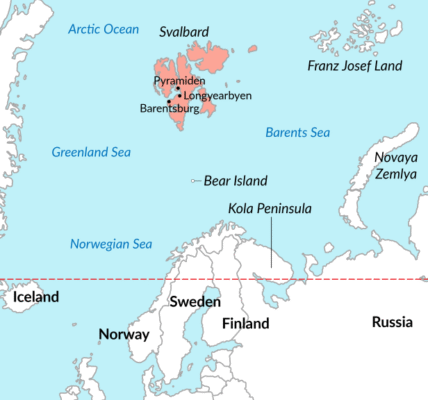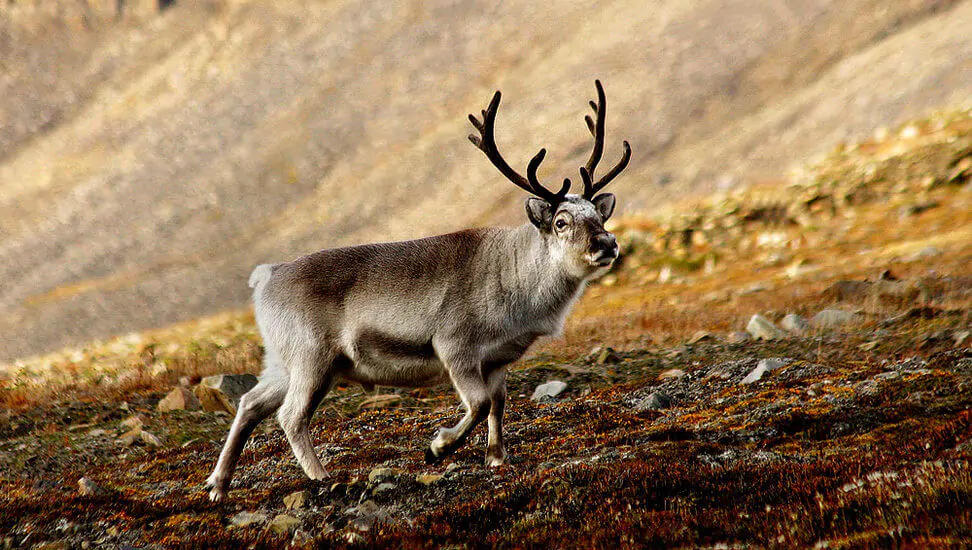
There is no Santa Claus and elves with his reindeer sled. Instead, there is global climate change and its multiple effects. The Northwest Passage is becoming more accessible to trade and war fleets. The walls of buildings set on permafrost are cracking. Storms are more frequent and violent, and the water of the northern seas is not only warmer, but also less salty and more acidic. The Far North is warming faster than other regions of the world, while the northern parts of the Barents Sea with the Svalbard archipelago are warming the fastest in the entire circumpolar zone. They are also losing the most pitch, or sea ice. Climate change is affecting the flora and fauna of the Arctic. The warming is not sparing anyone or anything. It affects marine and terrestrial organisms alike, both permanent residents and migrants who show up only for the Arctic summer. This is perfectly illustrated by the reindeer and their caretakers – the Saami [1].
The winter that rains – the new face of Arctic weather
The phenomenon of rain on snow (ROS) has become a spectacular effect of rising winter air temperatures. The tundras of the high Arctic, including Svalbard, are increasingly experiencing extreme thaws. Thaws so hot that rain instead of snow pours from the aurora borealis-lit sky. The low, pillowy and bushy vegetation of the tundra becomes trapped in what is known as basal (basal) ice, that is, which is formed near the ground surface, while covering the lichens, mosses, their vascular doublets, i.e., rockeries, and, finally, the graminoids (sedges, cattails, sythes and grasses proper) and polar shrubs that stand above. The long-term effects of winters with rain and the other effects of climate change on plants, reindeer and local predators seem easy to predict. However, there is still much we do not know about them [1, 3].
Ice over lichen – the mechanism of starving reindeer winters
Reindeer are unique in many ways. They are the only cervids in which antlers can also boast ladies (cows, doe). Their vast, all-around polar range is quite fragmented. Scientists and breeders argue to this day whether all reindeer belong to a single species, divided into more than a dozen subspecies, or whether we are dealing with several, distinct species. All of them are perfectly adapted to digging out local wild greens from under a thick quilt of snow powder. However, they are becoming helpless in the face of increasingly thick layers of ice on lichen, sedges or polar willows. They have to spend more time and energy chewing up these vegetal icicles or searching for pastures unsprayed by rain on snow. So this energy is becoming increasingly scarce to maintain body temperature, as well as to keep their senses alert. And lovers of their meat are not in short supply [1, 2].
Rhines have developed several ways to deal with the hard and thick coating of ice on lichens. They can undertake treks south to eat weevils and chard from the trees and undergrowth of the taiga. They are able to switch their winter diet to some extent from one based mainly on lichens to one composed of grassy plants and creeping oak shrubs or Arctic willows. They increasingly feed on brown algae and other showy algae on seashores.
This type of food became available only a dozen or so years ago, when the ice cover of the coasts began to shrink (in time and space). It is the consumption of seaweed that saves the endemic Svalbard rheas from starvation. Evidence of this was provided by research conducted during the winter of 2006-15.

Today, it is no longer necessary to kill these animals or even take samples of their blood with a syringe. It is enough to analyze the concentration of the stable isotopes of carbon δ13C, nitrogen δ15N and sulfur δ34S in the fresh feces of these deer and a variety of lichen, algae, mosses and flowering plants. The reindeer has long enjoyed a reputation as an excellent swimmer, forcing its way across the vast rivers of Siberia by swim, as well as reaching the islands of the Arctic seas on its own power. Nevertheless, this new marine dimension to the terrestrial herbivore’s niche shows how global warming is modifying food webs in unexpected places.
It’s unclear how long this kelp eldorado will be available to Spitzbergian stags. After all, human demand for algae is growing rapidly. More and more species need to be cultivated to satisfy the growing appetites of agriculture, the food and cosmetic industries. Both on Svalbard and in Chukotka and Alaska, mass die-offs of animals we associate with Santa’s sled have already been reported [3].
When Arctic rivers don’t freeze over like they used to – migrations on choppy trails
Not only birds and salmon migrate, but also reindeer. Some subspecies, such as: the Finnish reindeer and the tundra caribou, migrate as far as the wildebeest in Africa. Others, such as the Canadian taiga caribou and the Grant’s caribou of western Alaska, are more sedentary. They undertake only short migrations behind lichen or sedges free of the troublesome coating of ice. The rhynes of the Rocky Mountains, the Urals and the Altai descend into the valleys in winter, only to return to the crags in summer.
When rivers don’t freeze as they used to, it’s easier to fall prey to predators. Especially now that other prey is dwindling, as the bulk of salmon come from aquaculture. The number of hunters is also increasing, as the wolverine has been successfully reintroduced to the wild in Scandinavia.


Disjointed trails are not the only problems for the draft animals of Nikolai, Tungusha and Samoyed. They are also being harmed by habitat loss associated with mining development. The Far North has long been tempted by gold and diamonds. Later they were joined by oil and gas, and now rare earth metals. The availability of lichens in the tundra and taiga transition zone is strongly influenced by current forest management. Scandinavia’s forests are being logged earlier today than they were a few decades ago. Native tree species are giving way to dune pine imported from America.
For foresters, it’s profit, for rhenus, it’s starvation (since far fewer lichens grow under the canopy of this pine than in the loose canopy of native conifers) plus problems getting through the dense, low-branching stand.
Someone will say: Oh there, oh there! Both humans and rhenos have already survived a number of climatic changes. Suffice it to mention that 2 million years ago, northern Greenland was on average 10-14°C warmer. They do. In addition to reindeer, it was then inhabited by mastodonts, mammoths, as well as innumerable flocks of hares, barks and geese. Animals were so rich in terms of biomass, number of species and multiplicity of life strategies because the plant cover was much richer than today. In addition to the species that grow in Greenland today, there were also thuyas, yews and balsam poplars, familiar from our urban greenery. The ecosystem there has no counterparts in modern nature.
The remnants of typical species are preserved not only in the Arctic, but also in the deserts of Central Asia, the highest mountain ranges of Eurasia and North America, and finally in a few zoos. Plenty of species, however, have become extinct [4]. The effects of the disruption of Arctic migration routes can also be seen here in Poland, for example, at the Sulejowski Lagoon in the Łódź region or Dzierżno Duże in Silesia. More and more typically marine and Arctic at the same time ducks and newts are wintering there, for which theoretically it should be too warm here, especially now.
What about the Saami – traditional reindeer husbandry in the climate on steroids
The climate on steroids harms not only the ren, but also the people living in close symbiosis with them, such as the Saami. They are the indigenous inhabitants of Lapland, a historical land on the northern edges of Russia, Finland, Norway and Sweden. As late as the 16th and 17th centuries, they were still forging a life of hunter-gatherers. About 400 years ago, they became reindeer herders. Current climate change may force them to make another, equally profound lifestyle change. For now, however, together with urban activists of Scandinavian countries, they are defending their lands against the expansion of mining and forestry based on alien species. What separates them from environmentalists, however, is their attitude toward large predators, especially the reintroduced wolverine. Reindeer are increasingly feeding on algae in the sea. Northern peoples, too, have responded to climate change by making more intensive use of the gifts of the sea and less of the land. This is how the Inuit avoided extinction when Greenland ceased to be a green island. This is also how the Saami’s distant neighbors, the Chukchi, had to cope when the Little Ice Age began [5, 6].

Similar crises affected many other ren-dependent communities, from the Siberian Chukchi and Tungusha, to the Mongolian Tsaatan (Dukha), to the Inuit and Native Americans [5]. Rhenish hunters were also the inhabitants of Europe during the Ice Age. Paintings of Lascaux and Altamira remain of them. Traces of their encampments have been preserved in Wigry National Park and the Kissing swamp, among others. Archaeological research in Lublin shows how the culture of reindeer hunters became that of suhak hunters. In the Beka reserve, in turn, it is possible to trace their transformation into seal hunters, analogous to that undergone by the Chukchi during the Little Ice Age of the 16th-17th centuries.[6]
In the article, I used:
- Descamps, S., Aars, J., Fuglei, E., Kovacs, K. M., Lydersen, C., Pavlova, O., …. & Strøm, H. (2017). Climate change impacts on wildlife in a High Arctic archipelago-Svalbard, Norway. Global Change Biology, 23(2), 490-502.
- Dussex, N., Bieker, V. C., Sun, X., Le Moullec, M., Ersmark, E., Røed, K. H., …. & Martin, M. D. (2025). The Genomic Basis of the Svalbard Reindeer’s Adaptation to an Extreme Arctic Environment. Genome Biology and Evolution, 17(9), evaf160.
- Hansen, B. B., Lorentzen, J. R., Welker, J. M., Varpe, Ø., Aanes, R., Beumer, L. T., & Pedersen, Å. Ø. (2019). Reindeer turning maritime: Ice-locked tundra triggers changes in dietary niche utilization. Ecosphere, 10(4), e02672.
- Kjær, K. H., Winther Pedersen, M., De Sanctis, B., De Cahsan, B., Korneliussen, T. S., Michelsen, C. S., …. & Willerslev, E. (2022). A 2-million-year-old ecosystem in Greenland uncovered by environmental DNA. Nature, 612(7939), 283-291.
- Tyler, N. J., Turi, J. M., Sundset, M. A., Bull, K. S., Sara, M. N., Reinert, E., … & Corell, R. W. (2007). Saami reindeer pastoralism under climate change: Applying a generalized framework for vulnerability studies to a sub-arctic social-ecological system. Global Environmental Change, 17(2), 191-206.
- https://wiadomosci.onet.pl/kiosk/czarnoskora-naloznica-czukczy/gt7b6 [accessed 6/12/2025].
Source – https://wodnesprawy.pl/en/reindeer-on-thin-ice-on-how-winter-rain-is-changing-the-arctic/