Arctic Today reported that scientists from the Gulf of Maine Research Institute clarified public concerns about a collapse of the Atlantic Meridional Overturning Circulation (AMOC). Observational records show the AMOC has weakened by approximately 15 percent since the mid-20th century, linked to Greenland ice melt and increased freshwater input. The Intergovernmental Panel on Climate Change (IPCC) concluded the AMOC will weaken gradually over the 21st century, but a collapse before 2100 is very unlikely. (Arctic Today)
The AMOC weakening carries serious implications for Arctic communities. The Atlantic Meridional Overturning Circulation functions as a massive conveyor belt transporting warm water northward and returning cold water south, playing a crucial role in regulating northern climates and marine ecosystems. The 15 percent decline since the mid-20th century demonstrates how Greenland ice melt directly affects global ocean circulation patterns, creating a feedback loop where Arctic warming weakens the very system that moderates northern climates. This gradual weakening will reshape Arctic ecosystems and economies even without the dramatic collapse headlines suggest.
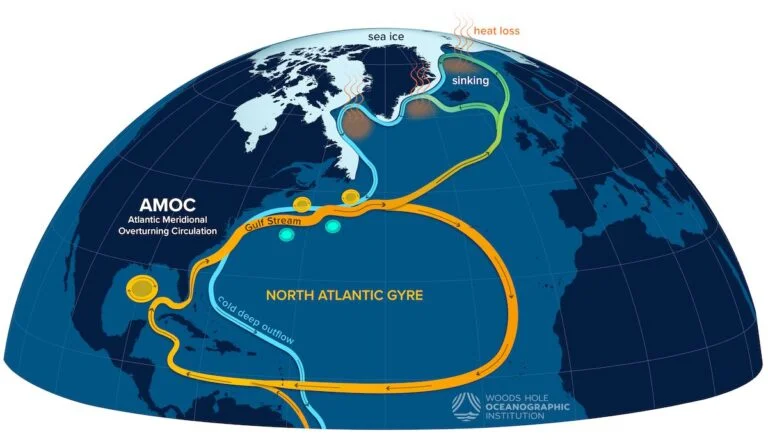
Communities dependent on predictable ocean conditions will be affected by altered nutrient distributions, shifting fish populations, and changing weather patterns. The emphasis on global emissions reductions to slow AMOC weakening highlights the need for Arctic communities to focus on adaptation strategies. Arctic governance must prioritize developing climate-resilient fisheries management and planning infrastructure for changing conditions, recognizing that Arctic communities experiencing disproportionate climate impacts deserve adequate resources to address the disruptive impacts they face. (Carbon Brief, IPCC, Nature)
Source – https://www.thearcticinstitute.org/arctic-week-take-five-week-8-december-2025/