Ambler Access Road, approved by Trump administration, designed to reach massive copper deposits.
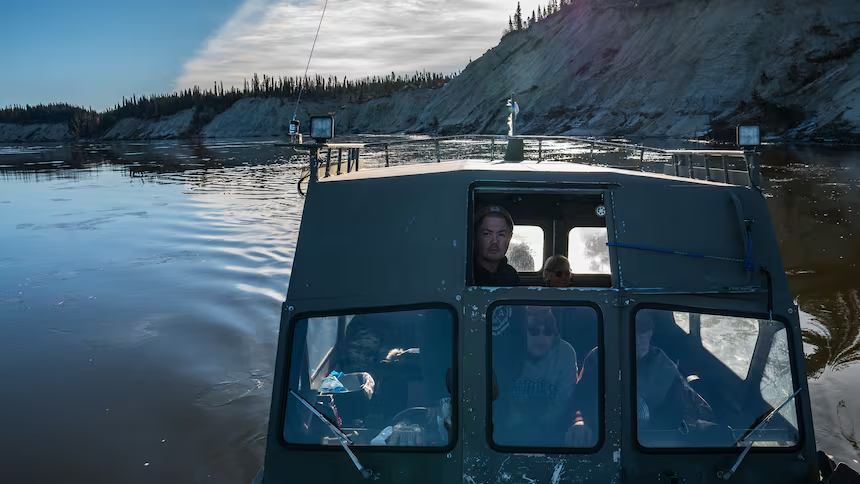
Ice blocks drift past Tristen Pattee’s boat as he scans the banks of Northwest Alaska’s Kobuk River for caribou. His great uncle Ernest steadies a rifle on his lap. It’s the last day of September, and by every measure of history and memory, thousands should have crossed by now.
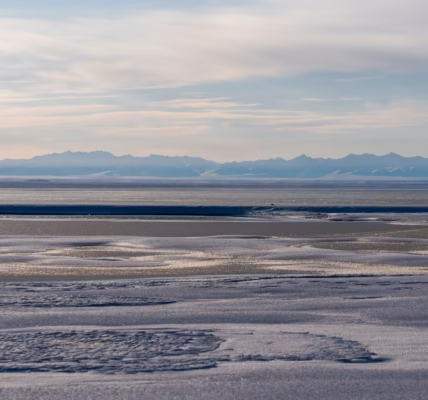
But the tundra is empty, save for the mountains looming on the horizon — the Gates of the Arctic National Park.
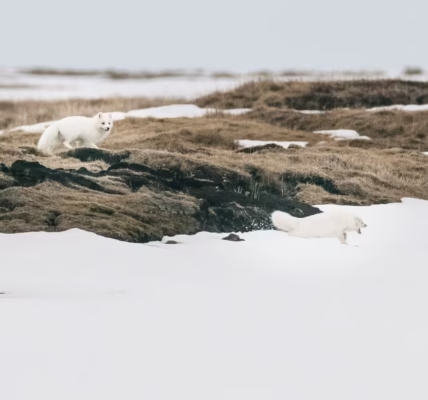
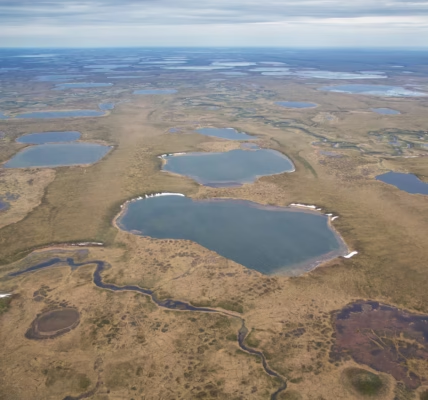
Days after Pattee’s unsuccessful hunt, the Trump administration approved construction of the Ambler Access Road — a 340-kilometre route designed to reach massive copper deposits that would cut through that wilderness, crossing 11 major rivers and thousands of streams where salmon spawn and caribou migrate.
The approval, which is facing lawsuits though proponents believe construction could start next year, came as record rainfall in Northwest Alaska flooded villages and ripped through fish spawning habitat — the latest climate-driven blow to Indigenous communities already watching caribou and salmon numbers plummet.
As the co-owner of a wilderness guiding company in Ambler, Pattee’s livelihood depends on keeping this landscape intact. An Inupiaq hunter, his ability to feed his family and continue the subsistence traditions of his ancestors depends on healthy caribou and fish populations.
Yet he supports building the road.
“Everything takes money nowadays,” said Pattee, who serves on Northwest Arctic Subsistence Regional Advisory Council, a federal advisory group.

Jobs in local villages are scarce, and with gasoline at $17.50 a gallon, the ability to power all-terrain vehicles and boats needed to hunt is out of reach for many.
Mining jobs, Pattee believes, would offer a lifeline, and the minerals could slow the climate shifts that are threatening his subsistence way of life.
It’s the irony of climate change in Northwest Alaska: the minerals needed to power the green energy transition sit beneath some of the continent’s last pristine wilderness — a landscape already on the frontlines of the climate crisis, where temperatures are rising four times faster than the rest of the planet.
The decline before the road
Over the last two decades, the Western Arctic Caribou Herd has plummeted from nearly half a million to some 164,000 — a 66 per cent decline, according to the Alaska Department of Fish and Game.
While caribou populations naturally fluctuate, scientists say the increasingly delayed cold and snow that triggers the migration south has caused caribou to remain in the Brooks Range, where they are difficult for hunters to access.
The day after Pattee’s unsuccessful hunt, the first snow fell. On Oct. 6 — far later than historical norms — caribou began trickling across the Kobuk.

Then the rains came, bringing heavy, late-season downpours that scientists say are becoming more common in the warming Arctic and devastating for salmon. Intense rainfall can damage and dislodge eggs, while rising water temperatures reduce oxygen levels fish need to journey upstream.
One recent study found dozens of clear streams in the Brooks Range have turned orange with toxic levels of metals — changes researchers believe is the result of permafrost thaw — which may help explain recent drops in salmon numbers. Chinook and chum salmon in particular are experiencing “sustained and dramatic declines” with periodic population crashes, which has led to complete closures of some fisheries, according to NOAA Fisheries.
Experts worry about what this year’s record storms will mean for future runs.
“Elders who’ve lived here their entire lives have never seen environmental conditions like this and they’ve never seen fish conditions this poor,” said Alex Whiting, environmental program director for the Native Village of Kotzebue.
Adding pressure to a buckling landscape
The Ambler Road would add its own pressures. Thousands of culverts and nearly 50 bridges would disrupt water flow and fish passages, and more than 100 trucks would traverse the road daily over the decades-long production period.
Federal biologists warn the region’s rocks contain naturally occurring asbestos and that heavy traffic would kick up dust that would settle on thousands of waterways as well as the vegetation caribou depend on.

The road would also fragment the habitat of the Western Arctic Caribou Herd, potentially hindering migration patterns. The Bureau of Land Management designated some 1.2 million acres of nearby salmon spawning and caribou calving habitat as “critical environmental concern.”
Then there’s the mine. Vast amounts of water would be drawn from rivers and lakes, while groundwater levels and permafrost would be permanently disrupted. The operation would generate enormous quantities of waste rock and require a tailings facility to store toxic slurry, risking spills that could send heavy metals into waterways.
In an emailed statement, Kaleb Froehlich, managing director of Ambler Metals, the company behind the mining project, said the operation would use proven safety controls for permafrost and will treat all water from the mining process to strict standards. The company also tracks precipitation to size facilities for heavier rainfall and has a binding agreement with NANA, an Alaska Native corporation, to prioritize recruitment from nearby communities.
The carbon footprint of decarbonizing
Critical minerals are becoming increasingly vital — growing demand for green energy technologies could scale production by nearly 500 per cent by 2050, according to a 2020 World Bank report.
The Arctic deposit would yield not just copper, but also zinc, lead, silver and gold. At an estimated 46.7 million tons of mineral reserves, it ranks among the largest undeveloped polymetallic deposits in North America.

But there’s no guarantee the minerals would fuel clean energy. President Donald Trump has spoken openly about his disdain for electric vehicles and wind power, and the majority of copper in the U.S. goes to construction projects, according to the Copper Development Association.
The Trump administration has framed the issue as one of national security and deemed reliance on “hostile foreign powers’ mineral production” an acute threat. In March, the White House issued an executive order instructing the Secretary of the Interior to prioritize mineral production and mining as the primary land use on all federal lands known to hold mineral deposits.
The real issue isn’t whether the minerals are needed — it’s who gets to decide, said Andrea Marston, an associate professor of geography at Rutgers University who studies mining and Indigenous rights in the Americas.

Mining projects like Ambler are sometimes located on Indigenous lands, creating what she calls a false ethical dilemma: mine to save the climate, or protect the land and perpetuate warming. That framing, she argues, obscures other possibilities like investing in mass public transportation, recycling minerals that already exist and designing systems that consume less.
“You cannot justify steamrolling Indigenous lands with a kind of global story of climate change because that just ends up reiterating colonial plunder in a new way,” she said. “The starting point should be: it is their land to decide what to do with.”
For Pattee, the jobs represent more than income — they would allow people to reconnect with their culture. Young Inupiaq hunters once took immense pride in providing for their families, he said.
“That was their proud moment. That was what they lived for,” he said. “Nowadays, without being able to afford hunting, a lot of that’s been taken away.”
The night after his unsuccessful hunt, Pattee and his family gathered around a table of bowhead whale, beluga, seal and moose — a rare meal all together as relatives had flown in from Anchorage.

Like many in Ambler, Pattee’s family members have left over the years to find jobs. In a village this small, each departure is felt — the population has dwindled from 320 in 2010 to some 200 today.
“We’re losing our community. We’re literally losing it,” he said. “People want to be home but they just don’t have the opportunities to keep them there.”