Remote Faroe Islands in Arctic are in talks to add an extra undersea internet cable to safeguard communications from sabotage.
Arctic leaders have warned that the threat of hybrid warfare including the sabotage of undersea internet cables by Russia and others is moving from the Baltic Sea to the far north.
Denmark and Greenland plan to build a new data cable between them, and the remote Faroe Islands are in talks to have the line routed through their archipelago to bolster their resilience against potential attacks, according to the prime minister of the islands.
“When you are an island in the middle of the north Atlantic, you are vulnerable,” Aksel Johannesen said. ‘‘We have two telecommunications cables today, and if both are attacked at the same time we do not have any connection with the world.”
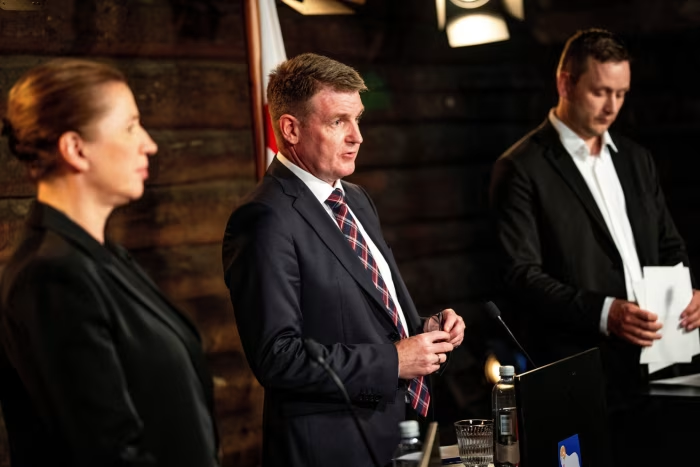
Aksel V. Johannesen speaks at a press conference, with Mette Frederiksen and Jens-Frederik Nielsen standing nearby.
The Arctic’s remoteness and sparse population make it vulnerable to the kind of hybrid threats seen across Europe in recent months — from sabotage of Baltic Sea internet and electricity cables to airspace violations. While the region has so far avoided high-profile incidents, officials suspect some attacks may have occurred unnoticed.
There have also been a slew of lower-level sabotage events in Europe — some of which have been attributed to Russia — from arson to vandalism of ministers’ property.
Aaja Chemnitz, a Greenlandic MP in Denmark’s parliament, said that the vast Arctic island had one internet cable from Canada and one from Iceland — before the new link to Denmark comes online. Building an extra cable helps ensure that if one link is damaged, others can keep communications flowing.
“The vulnerability that you see in the western world, you can times it by 1,000 here. If you cut one of our cables, we won’t have internet for six to nine months,” Chemnitz said, adding that Greenland lacked surveillance capacity to track any attacks that did happen.
Several cables have been damaged in the Arctic or nearby but no perpetrator has been identified. The cable connecting the Shetland, Orkney and Faroe Islands with Scotland has been damaged three times recently, once in 2022 and twice in 2025, affecting internet availability on the Scottish islands.
A data cable to the Norwegian Arctic Archipelago of Svalbard was damaged in January 2022. Public broadcaster NRK established that a Russian fishing boat crossed it more than 140 times beforehand, but prosecutors shelved the case.
Denmark said last month that it would spend $8.7bn on F-35 fighter jets and boosting Arctic security, including the new cable to Greenland. It added that it would discuss with the Faroe Islands the possibility of connecting the archipelago too.
Greenland and the Faroe Islands are self-governing territories of the kingdom of Denmark.
Johannesen said that a Faroese government proposal to join sanctions by Norway and the EU on two Russian fishing companies “that are perhaps doing some spying has nothing to do with the war in Ukraine, it’s more about hybrid attacks”.
The Faroese government had suggested a third cable in talks with Copenhagen last year. “The risk would still be there but it would be lower,” the prime minister added.
Many of the Arctic countries have backup deals with satellite companies for internet, but these cover only a small proportion of communication. Chemnitz said it was about 1 per cent for Greenland.
Kristrún Frostadóttir, Iceland’s prime minister, told the Financial Times that Iceland had a backup deal that was “enough for critical needs”.
She added: “Everyone is thinking about hybrid . . . To an extent, we are prepared; to an extent, we are not. We have participated in talks on cables and the Baltic Sea. Like the Faroes, Iceland is very sensitive to any sort of cut off. We share intelligence. We share learnings.”
Source – https://www.ft.com/content/f4aec448-abf5-47d1-abca-6829736bfcb1