- Stockholm’s Arctic strategy predates the full-scale invasion of Ukraine and Sweden’s accession to NATO.
- An update that shifts the government’s focus in the North to the single goal of deterring Russian aggression is essential—and Sweden’s economy, politics, and defense industry are ready for it.
- Sweden should ground its deterrence-by-denial approach in improved domestic military capabilities and integration with Nordic and EU partners.
The Swedish government is crafting a new Arctic strategy, updating its 2020 document of the same name and building on its 2024 National Security Strategy. This makes indubitable sense. The last five years have seen significant global developments, including a pandemic, Russia reinvading Ukraine, a European energy transition, increased great-power competition, and the rise of artificial intelligence, unmanned warfare, and other potentially disruptive technologies. The Nordic-Baltic-Arctic region was not immune to changes. Finland and Sweden joined NATO. The Arctic saw greater levels of military activity. The Arctic Council ceased having in-person meetings with Russia. Data showed that the Arctic was warming four times faster than the rest of the planet.1 Ice melt could lead to increased economic opportunities in northern latitudes but also potential environmental and cultural dislocation for northern inhabitants. Those developments suggest a need for a revised Arctic strategy.
In this issue brief, I explore the contours of a hypothetical Swedish Arctic strategy given today’s circumstances. What follows is a thought experiment on what would be a logically consistent strategy that achieves reasonable objectives given available means, while minimizing risks associated with the strategy. I begin by reviewing existing Swedish government priorities, the domestic constraints facing Sweden’s government, and Swedish capabilities. I then turn to an assessment of the global context as one might perceive it from Stockholm’s perspective. The strategy follows, with a discussion of a prioritized objective, strategic approaches to meet that objective, and how to minimize risks associated with those approaches.
Existing priorities, domestic politics, and Swedish capabilities
Protecting the Arctic is crucial to our national and to our collective security. For Sweden, the Arctic is an area where national and international interests intersect.
—Maria Malmer Stenergard, Sweden’s minister for foreign affairs2
Strategies do not exist in a vacuum. Absent a dramatic exogenous shock, we would expect any future Arctic strategy to be relatively consistent with preexisting policies. For example, Sweden has a long history of supporting the rule of law, which makes sense for a relatively small country seeking to insulate itself from the whims of more powerful neighbors and to enhance its own voice in international affairs. The most recent manifestations of that predilection include Sweden’s advocacy of an EU policy for the Arctic; Sweden’s support for Ukraine in its war against Russian aggression even at the expense of Sweden’s other foreign aid projects; and, in the Arctic context, the importance of the Arctic Council for Arctic governance.3 We would expect any Arctic strategy acceptable to government stakeholders to reinforce, or at least not undercut, those core initiatives.
This is particularly true for identified national interests. Sweden released a National Security Strategy (NSS) in 2024. The vital interests listed in the Swedish NSS fell naturally into three categories: security, which includes the protection of Sweden’s sovereignty, independence, freedom of action, and allied defense; a functional, resilient society; and support of Swedish values, including democracy, the rule of law, and the protection of rights. Limited interests listed in the NSS included a rules-based, democratic, connected, and united Europe and the United States, robust domestic safety, and multifaceted resiliency. I would not expect the new Arctic strategy to diverge substantially from this characterization.
Relative consistency is also reinforced by Sweden’s government structure. Sweden is a parliamentary democracy with a tradition of consensual policies promulgated by coalition governments. On the security front, Sweden uses periodic Defense Commissions to get cross-party buy-in for multiyear budgets and long-term defense initiatives. This helps insulate foreign and security policy from changes in government coalitions. (The same might not be true for domestic policy initiatives, which are often the battlefield over which elections are fought.) Cross-party agreement in the Riksdag, Sweden’s parliament, is yet another reason why we would expect relative continuity between documents across time, including the forthcoming Arctic strategy.
Capabilities also matter. Strategies with overly ambitious goals relative to available capabilities suffer from the classic ends-means mismatch. Adequate capabilities are vital for determining the feasibility and sustainability of any strategy. Sweden has respectable capabilities for a country of 10.6 million people but is by no means a European great power.
On the diplomatic front, Sweden’s foreign service has approximately 2,700 employees, of whom eight hundred are based in Stockholm while five hundred work abroad in Sweden’s one hundred or so international missions, supported by fourteen hundred local staff.4 Sweden has embassies in all Arctic nations as well as in Brussels. Sweden has a dedicated Arctic ambassador portfolio handling circumpolar issues. These capabilities give Sweden a voice in Arctic developments.
In terms of gathering and processing information, Sweden has three main intelligence entities. The Swedish Security Service (SAPO) employs roughly 1,500 people focused on counterterrorism and counterintelligence. The nine-hundred-person National Defense Radio Establishment (FRA) is focused on signals intelligence collection and has a very good reputation. Finally, the Military Intelligence and Security Service (MUST) collects and analyzes military and security information. In addition to these formal intelligence agencies, the nine-hundred-person Swedish Defense Research Agency (FOI) is a Swedish government resource capable of intelligence analysis, though that is not its sole purpose. Finally, Sweden is in the process of creating a new civilian foreign intelligence agency to complement and build upon existing intelligence capabilities.5
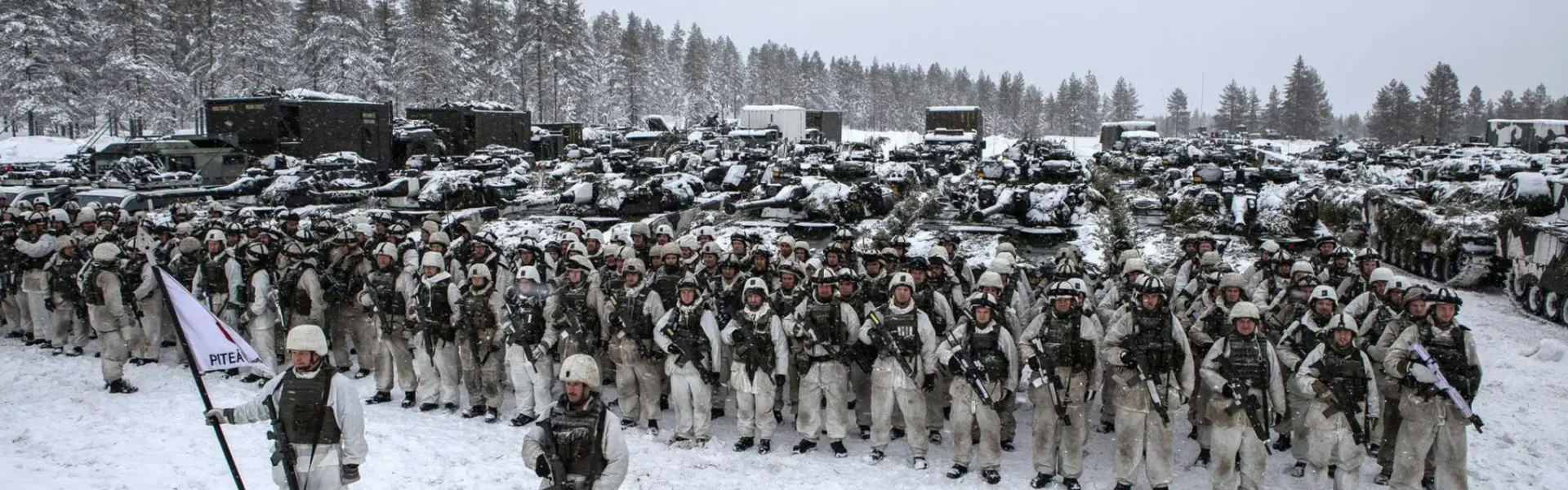
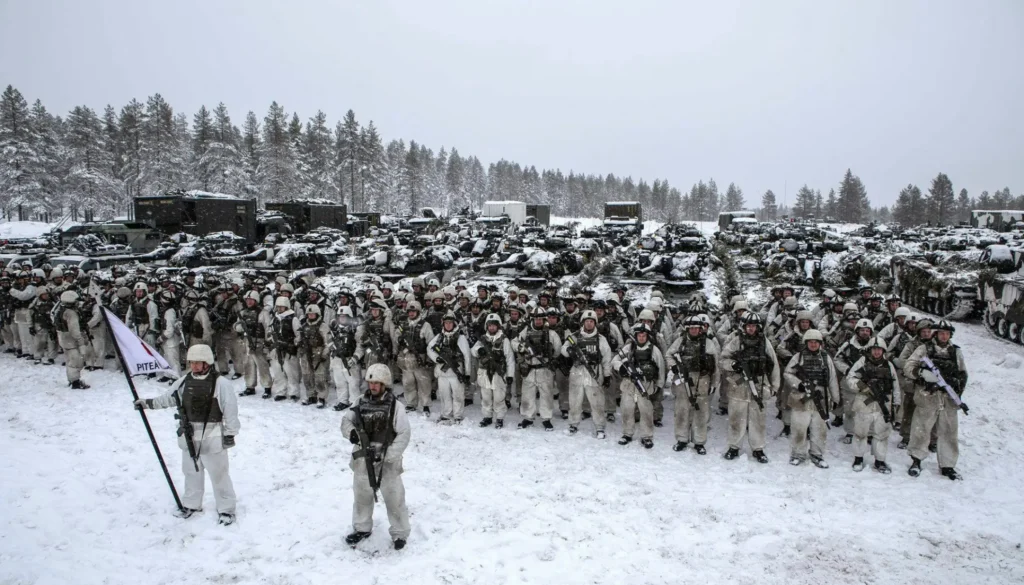
Sweden is expanding its relatively small military. The Swedes maintain a very capable air force, are modernizing their navy, and have a relatively robust defense industry (dominated by Saab and BAE Systems) whose growth is a government priority. They have created a new NSC system with a national security advisor, a new Civil Defense Ministry with authorities in emergency preparedness, and a reorganized defense ministry. The Swedish government has dramatically increased the defense budget, tripling it over the last seven years and doubling it within the last four.6 It has committed to meeting NATO’s defense spending goals of 3.5 percent of gross domestic product (GDP) for direct spending and an additional 1.5 percent for infrastructure spending, as specified in the July 2025 NATO Summit communique. As part of that effort, the Swedish army will create two northern mechanized brigades, each with a motorized rifle battalion, and will also acquire up to four frigates for service beyond the Baltic Sea.7 Sweden has volunteered to lead NATO’s Forward Land Force in northern Finland. Sweden’s defense efforts are bolstered by comprehensive defense planning—called Total Defence—that includes roles for the Swedish population writ large and Sweden’s private sector in the event of war, as well as a renewed emphasis on societal resilience.
Sweden has the largest economy of the Nordic states. It has a low national debt and ranks high in competitiveness indexes.8 Sweden is a member of the EU, giving it access to the continental market. The economy is highly dependent on trade through the Baltic Sea. Sweden’s total imports and exports represent roughly $400 billion in economic activity, with Germany, Norway, and Denmark its largest trading partners.9 The Swedes fear depopulation and economic stagnation in their northern regions and have attempted to build a green northern economy to attract workers, with mixed success.10 The positives include the Esrange space launch facility and the LKAB iron ore mine, both outside Kiruna. The Northvolt battery initiative did not fare as well, filing for bankruptcy in early 2025. That said, Sweden has a reputation as a low-corruption, high-wealth, stable trading partner with an innovative economy.
The international context
For many years, the Arctic region was seen as a peaceful zone of cooperation. That era ended with Russia’s full-scale invasion of Ukraine in 2022. Security policy now plays a greater role in Arctic affairs than it did before 2022. That is the main reason why the Swedish Government will present a new, updated Arctic strategy next spring.
—Maria Malmer Stenergard11
To have any chance of success, strategies must account for the current and future international context. Swedish foreign policy has been dominated by four large events. The first was the aftermath of Russia’s 2014 invasion of Ukraine and annexation of Crimea. This created a sea change in Swedish rhetoric and policy toward Russia. No longer was Russia portrayed as a potential partner. Instead, successive Swedish governments recognized Russia as posing a significant threat to European stability and Swedish sovereignty. A recognition also emerged that conflict between NATO and Russia would spill into the Nordic-Baltic region and affect Sweden. In reaction to Russian aggression, Sweden would negotiate new defense partnership agreements with Finland, with all of Sweden’s Nordic neighbors, and with the United States; develop and participate in large-scale military exercises against possible Russian attack; reactivate its military conscription program; station a larger military force on Gotland island in the Baltic Sea; and begin a general rearmament program.
The second event was the Syrian refugee crisis of 2015 and 2016. Sweden took in more than 160,000 refugees in 2015 alone, equal to 1.6 percent of Sweden’s population. Swedes were overwhelmed by the sheer volume, leading the government to close the border with Denmark in 2016 and dramatically tighten asylum laws. The refugee situation and growing youth violence led to a crisis in Swedish governance. The influx undermined the left-leaning governing coalition’s popularity while support grew for the nationalist Sweden Democrats party. Prime Minister Stefan Lofven of the Social Democrats lost parliamentary confidence in late September 2018. The main political factions—the Red-Greens and the Alliance—then spent four months arguing about who should lead the government.12 Lofven’s Red-Green coalition eventually came out on top but would be replaced in 2022 by a conservative governing coalition led by Ulf Kristersson of the Moderate Party.13 Election issues centered around immigration, crime, and electricity prices. The important point was that cross-party unity on external security policy did not necessarily translate to consensus on domestic policy issues.
The third shock was Russia’s reinvasion of Ukraine in 2022. The Ukraine war focused Sweden’s security policy on the Baltic Sea and Russia’s threat to international order and international law. Government statements painted a grim picture, noting the Russian military threat in the Baltic Sea as well as the threat of Russian-backed gray zone activities.14 As discussed below, Sweden increased its defense spending in response and abandoned its nonaligned posture by joining NATO. The Arctic Council ceased formal meetings, though working groups continued without their Russian counterparts.
The fourth and final shock is recent changes in US foreign and security policy. Sweden, like the rest of the EU, was hit with steep US tariffs early in President Donald Trump’s second term.15 Soon after, a Pew global survey noted that 79 percent of Swedish respondents had an unfavorable view of the United States, a dramatic change from the 44-percent unfavorable view in 2024.16 On the security front, Sweden has been a steadfast supporter of Ukraine and does not share the Trump administration’s desire to end the war quickly if that comes at Ukraine’s expense.17 The Trump administration’s new National Security Strategy is a clear example of this transatlantic disconnect. It warned, “The Trump Administration finds itself at odds with European officials who hold unrealistic expectations for the war perched in unstable minority governments, many of which trample on basic principles of democracy to suppress opposition.”18 The US strategy noted that Europe should take “primary responsibility for its own defense,” with a target date of 2027 for doing so.19 Together, these initiatives signified that, from a US perspective, European nations including Sweden need to dramatically increase their focus on military security. That shook Europe. EU Defense Commissioner Andrius Kubilius exemplified the European reaction: “The question is whether we need to have some kind of additional security guarantees and institutional arrangements in order to be ready—in case Article 5 suddenly is not implemented.”20
Assumptions, objective, strategic approaches, and risks
With all this as background, what might a prudent Swedish Arctic strategy entail? It cannot veer too far from the priorities listed in the 2024 Swedish NSS or undermine any cross-party defense agreements in the Riksdag. It must be capable of being implemented with somewhat limited means and in a parliamentary election year. It needs to account for a revanchist, aggressive Russia and do so without significant US assistance. And it needs to be consistent with longstanding Swedish principles, including the rule of law, the critical nature of the EU, and the usefulness of forums like the Arctic Council.
Assumptions: Any strategy requires assumptions. A first assumption is that this is a short-term strategy for the next four years, rather than Sweden’s strategy in perpetuity. I assume that the strategy will focus on the European Arctic rather than the circumpolar Arctic, given Sweden’s limited means. As noted in the earlier context section, I assume regional officials realize that the Nordic-Baltic-Arctic region is a military operating environment with the potential for spillover from one part of the region to another. I assume that Russia will continue to represent a threat to regional peace and stability for the duration of the strategy, and that China is not a direct threat to Sweden’s economy or security—or more broadly, to regional governance by the European Arctic nations, at least for the next four years.21 I further assume that the United States will prioritize the Western Hemisphere and East Asia over Europe, consistent with its NSS. I assume that the EU will remain unified in the face of US tariffs. I further assume a continuation of the Russia-Ukraine war, and that Germany, France, the United Kingdom, Poland, and the Nordic and Baltic states will continue to support Ukraine. Finally, I assume that NATO faces an uncertain future given emerging US policies.22
Objective and approaches: The strategy’s overall objective is to deter Russian aggression in the European Arctic. Achieving that objective requires a deterrence-by-denial approach toward Russia and a persuasion and inducement approach toward European allies that are concerned about the Russian threat.
Deterrence by denial requires developing the capabilities to deny an adversary the ability to achieve its objectives and signal to the adversary that one has those capabilities. From a military security perspective, that will require Sweden to improve its unilateral defense capabilities, especially in intelligence, surveillance, and reconnaissance (ISR), electronic warfare, air and drone defenses, distributed operations by small units, and unmanned systems, above levels in current plans. Sweden is taking steps in that direction, with the Riksdag borrowing $31 billion to fund increased defense spending and dramatically speeding up defense acquisition programs.23 According to Defense Minister Pål Jonson in October: “The Government is now taking steps to rapidly operationalize anti-drone capabilities and increase the availability of our combat aircraft. There is a significant need for new anti-drone capabilities, and we are shortening lead times by eight years. This will result in increased safety and security for the Swedish Armed Forces and for Sweden.”24
Unilateral capabilities are important signals to allies and adversaries alike, but they will be insufficient to deter a much larger adversary like Russia. Sweden must integrate more closely with its regional neighbors, particularly as a hedge against NATO’s uncertain future. Sweden should deepen its already excellent air force integration with Norway and Finland, and should consider adding Denmark to the mix. Sweden should consider proposing an explicit naval division of labor across the region, with Norway focused on the eastern Atlantic and Barents Sea, and Sweden and Germany focused on the Baltic Sea in joint operations that build on NATO’s Operation Eastern Sentry. Finland, Sweden, and Norway should consider dual-hatting the Forward Land Force in northern Finland as both a NATO command and a mini-multilateral force outside of NATO, and should expand it beyond a brigade size. In addition, the three countries should partner to diversify and standardize the rail lines connecting Finnish Lapland to Swedish Lapland and Norrbotten, and Norway’s Finnmark, Nordland, and Troms regions. To keep the US and Canadian militaries involved in the European Arctic, if only tangentially, Sweden should continue to support the Arctic Security Forces Roundtable and the Arctic Security Policy Roundtable. Finally, Sweden could take a larger role in efforts to integrate Total Defence and societal resilience both vertically within Sweden and horizontally across northern counties in Norway, Sweden, and Finland. This initiative would build on existing coordination efforts through more frequent exercises, first responder cross-training, and trilateral actions to protect critical infrastructure.25 Combined, these actions would signal to Russia that overt military or gray zone aggression in northern latitudes is doomed to fail.
These actions are not without costs and risks. A unilateral military buildup and increased multilateral operations and planning will require significant funds, likely above and beyond current budgets. The same holds true for improved rail infrastructure and multilateral operations. The stakes involved in the current moment, however, would seem to justify such additional expenditures. Moreover, these actions are consistent with current trends in terms of Sweden’s defense spending, focus on Total Defence, and need to keep trade routes open for continued economic viability.
In terms of risks, strategy is interactive. These actions could lead to a security dilemma in which Russia perceives Nordic defensive actions as offensive in nature and shifts its aggressive activities north. The counterargument, of course, is that Russia preys on weakness, so Swedish half measures would invite aggression, whereas a defensive buildup and visible societal resilience initiatives could forestall that aggression. Russia could respond by focusing its attention on a particular Nordic-Baltic-Arctic country, seeking to intimidate that target into inaction or neutrality. That risk can be countered with the strategy’s second line of effort.
Deterrence in the Nordic-Baltic-Arctic region can only succeed if allies signal their unified willingness to resist Russian aggression. Here, Sweden could position itself as a key interlocutor between the Nordic north and the rest of Europe through a combination of persuasion and inducements. The persuasive line of effort would see Sweden as a convening authority, facilitated by Sweden’s geographic location and its reputation for supporting multilateralism, international institutions like the EU and the Arctic Council, and the rule of law, as well as Sweden’s openness to non-Arctic countries playing a constructive role in the Arctic. It would also see Sweden taking a larger role in publicizing Russian gray zone activities and threats to the EU project. Sweden’s diplomatic presence across the Arctic and a willingness to declassify SAPO, FRA, and MUST intelligence analyses could facilitate regional coordination and broad-based public support for such coordination. Finally, the persuasive approach would see Sweden taking a leadership role in deepening classified intelligence sharing with likeminded governments.
Inducements could be used to further unify Western signals aimed at Russia. This might include larger, long-term contracts to Nordic defense industries to speed up procurement. This would improve Nordic interoperability and military integration, which sends a powerful signal to any aggressor.26 Inducements could include accelerating the construction of the LKAB critical mineral refining facility in Luleå and then offering refined products at below-market rates to countries taking an active role in deterrence-by-denial efforts in the north. Sweden could also offer to work with Norway on space launch and satellite management, as partners rather than competitors.
There are, of course, costs and risks for persuasion and inducements. This strategy calls on Sweden to focus more on the European theater and perhaps less on global issues. That comes as an opportunity cost and could potentially weaken Sweden’s reputation as a provider of international aid. Such a shift is justified, however, when we look at the Swedish NSS’s prioritization of interests. Inducements always cost money. Larger defense contracts, building a critical minerals processing facility, and expanding space launch are no exceptions. Again, the needs of the moment arguably necessitate such expenditures. Consensus already exists in the Riksdag to suspend debt limits and increase defense spending by 18 percent in 2026.27 Convening an off-cycle Defense Commission could provide additional cross-party support to sustain these initiatives. Moreover, Sweden is in a strong debt and fiscal situation, giving it the leeway to increase government outlays as recommended here.28 All this suggests that Sweden’s Arctic strategy could advocate successfully for greater government expenditures, even in an election year.
The largest risk in this portion of the strategy involves trust; trust that Nordic partners will be there for one another in a crisis, will use shared information responsibly, and will not take advantage of each other for short-term gain. Today’s threat environment and preexisting cultural and economic ties across the Nordic region should minimize that risk.
Conclusion
The last five years have witnessed dramatic changes to Sweden’s circumstances. The world suffered a pandemic. Russia is nakedly aggressive, both militarily in Ukraine and via gray zone actions across Europe. Sanctions against Russian energy forced Europe to change its energy portfolio. Drones, electronic warfare, and artificial intelligence have changed the character of war. The United States has new foreign policy priorities. And the Arctic is warming much faster than expected.
All this necessitates a new Swedish Arctic strategy. The notional strategy discussed above is heavily weighted toward security, which I believe is appropriate given today’s circumstances. Its goal is to deter Russian aggression in the European Arctic, which it does via two strategic approaches. The theory here is that urgently creating the needed capabilities for a deterrence-by-denial approach, and signaling the Nordic states’ willingness to resist Russian aggression, will lead Russia to reconsider its aggressive intentions. Sweden can improve that willingness through a series of persuasive and inducement actions aimed at its regional partners. The added benefit of these actions is that they prepare Sweden for war should deterrence fail. The strategy is not without costs and risks. Costs are consistent with current Swedish priorities and are bearable given Sweden’s economic power and resources and its tradition of cross-party consensus on security policy. The risks are arguably better, and certainly no worse, than doing nothing.
The time is ripe for a new Swedish Arctic strategy. The ideas put forward here are one possible way of crafting such a document.
About the author
David Auerswald is a nonresident senior fellow at the Transatlantic Security Initiative in the Atlantic Council’s Scowcroft Center for Strategy and Security. He is also professor of security studies at the US National War College in Washington, DC.
The views expressed here are the author’s own and not those of the National Defense University or any other US government entity.
Acknowledgements
This issue brief was made possible by support from the Swedish Ministry of Foreign Affairs. The Atlantic Council maintains a strict intellectual independence policy for all its projects and publications. The Council requires all donors to agree to the Council maintaining independent control of the content and conclusions of any products resulting from sponsored projects.